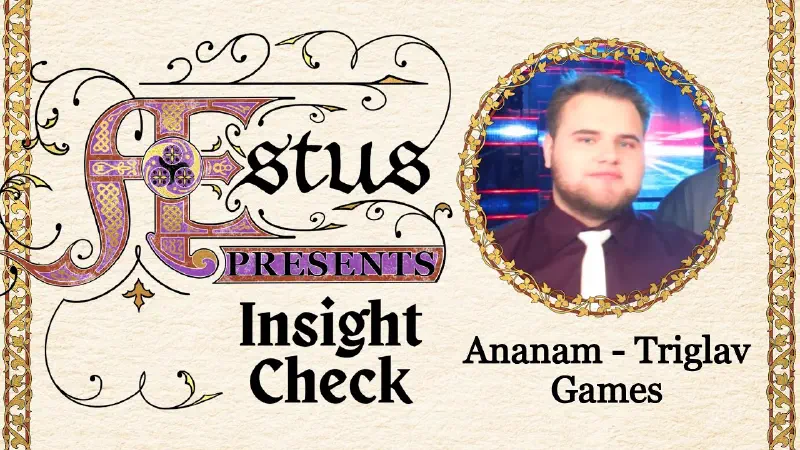
Ananam on Until the Last Villain Dies: Insight Check Episode 6
This article recaps a conversation from my Insight Check interview series. Watch the full interview below.
Introduction
Hey folks, Aestus here, back with another episode of Insight Check — the interview series where I sit down with the people designing and thinking hard about tabletop RPGs. This one is a conversation I’ve wanted to have for a while.
My guest is Mateusz Malarski, better known online as Ananam. Matt is a former esports player and commentator in StarCraft and Hearthstone, but if you’re in the Draw Steel third-party scene you almost certainly know him as the founder, designer, and director of Triglav Games. Triglav made a splash with their first product, Scions of Blood and Shadows, a vampire class supplement, and then again with Boggarts of Kingsmire, a swampy supplement that ended up as one of the most successful third-party Draw Steel crowdfunders to date. Their newest project, Until the Last Villain Dies, eclipsed even that just a few days into its campaign as of the time we recorded.
I’ll be honest about my interest here. Matt and I are in a very similar spot — both of us started making content for Draw Steel during the game’s early access, before it even released, betting on a game we loved. He just has a meaningful head start on me, and he’s been remarkably successful. So this was less an interview and more me getting to learn from a peer who has already walked some of the road ahead of me.
A Calculated Risk (And Some Bad Math)
What first got me genuinely interested in Matt as a designer wasn’t a product at all. It was a moment on a Goblin Points interview with our mutual friend John Denor — the first interview Matt did for the vampire project, back when it didn’t look like the crowdfunder was going to fund. John asked him why on earth he’d launched a crowdfunder for a Draw Steel product before Draw Steel itself had released, and Matt’s answer has stuck with me ever since. He leaned on the old internet meme: “the risk I took was calculated, but I am bad at math.”
I loved that, and I told him so. It would be easy to read it as a throwaway joke, but to me it revealed something more important — a willingness to evaluate his own mistakes, to laugh at them, and to keep going. I’ve come to believe that light-heartedness is one of the better indicators of resilience in this space. You cannot take your losses too seriously and survive as a small designer.
Matt didn’t dress it up. “I like overestimated people’s willingness to back a third party supplement before the game Draw Steel was even out,” he told me. “I was very optimistic and enthusiastic and I was gutted by how little traction it gained.” And he was candid that the stakes felt total at the time: “I am just so happy that in the end the vampire succeeded because if it didn’t I would probably quit and not do anything ever again for Draw Steel.”
He described the shape of that campaign in a way I think every first-time crowdfunder should hear, because I’m about to live it myself with Mythic Treasures. The thing ran roughly 35 days, a little longer than most. The start was strong, the ending was strong — but the middle was brutal. “The middle weeks of the crowdfunder are always like almost dead,” he said. “No one bugs, no one talks about it… you got very few backers, nothing happens and you are just depressed waiting for a miracle to happen.” If you back small RPG projects, remember that middle slump exists. It’s not a sign the project is failing. It’s just the shape of the curve.
Until the Last Villain Dies
We spent a good chunk of the conversation on the current campaign, because it’s genuinely unusual. Until the Last Villain Dies isn’t one project — it’s five, bundled into a single crowdfunder, and they’re wildly different from one another. The flagship is a second-echelon adventure (the title piece), and around it sit four more products: Rocks Fall, a battle-arena supplement; Murder of Corvin Whites, a raven-themed urban crime supplement; Upper Worlds Beware, a setting book for Timescape campaigns; and Grave Matter, a grab bag of dark-fantasy skeleton content with an ancestry, spell-gem items, and a first-level dungeon.
The Flagship Adventure
The flagship started, fittingly, as a team conversation. Matt has recruited some established names to Triglav, and his instinct as a leader is to let people work on what they’re passionate about rather than assign tasks. “Tell me what are you passionate about,” he said he asked them. “Tell me your best ideas and we’ll make it happen.”
The pitch that emerged — Matt thinks it originated with Jonas Tintenseher, though he was quick to credit Gavin Grant (GubDM), creator of the Kill class and adventures like Raiders of Ivy Watch, because “whatever idea people have, GubDM just makes them better” — was a Kill Bill-style revenge adventure. Instead of tracking down a list of assassins, the party hunts dragon knights who betrayed the good king Omund, which slots it neatly into the MCDM/Vasloria canon.
I confessed I’ve never actually seen Kill Bill, but I understood the structure: a kill list you work down, villain by villain, each one a set-piece boss encounter. Matt confirmed and expanded. An NPC ally — a dragon whose short name is Siri — is trying to keep the pieces of the Draco Genesis ritual out of the hands of Ajax, so he can’t produce more dragon knights. The evil dragon knights each hold a piece, Siri knows their locations, and she sends the party out to retrieve the parts and deal with their keepers. Crucially, they’ve built it to be modular: there are more chapters than you need, so a table can choose which dragon knights to pursue.
What struck me reading the material Matt sent over was how deeply it’s plugged into the shared Vasloria setting we’re all experimenting with right now. Matt has been following Matt Colville’s worldbuilding for years — his own home setting, he told me, “was always improved by and inspired by things that Matt was creating,” right down to importing Colville’s systems of warfare, organizations, and political drama. That lineage shows.
Rocks Fall and Dynamic Arenas
Rocks Fall was the part of the conversation where the game designer in me really lit up, because it’s the bestselling product in the entire crowdfunder — and Matt has a sharp theory about why. The supplement is built around what Triglav calls dynamic arenas: an additional mechanical layer over a combat encounter, where the environment is hostile to both sides. A blighted forest, an erupting volcano — each round, something happens.
Matt walked me through the design vocabulary. There are passive effects each round, and there are what he calls foreshadowed actions: at the start of a round, certain squares on the map are flagged for an incoming attack. “Erupting volcano has like rocks falling, magma rocks falling from the sky,” he explained. “You know in which squares the rocks will fall and you can run away before they fall — and you can also force move enemies onto the squares so that the rocks fall on them.” The damage is high, but you’re given time to maneuver around it. It’s a risk-reward puzzle layered on top of the tactical grid.
This hit home for me because I’ve been involved in tests of a very similar idea — drawing an area-of-effect on the map where, say, a tree branch will fall soon, and watching how that telegraph changes player decisions. We tested it in both 5e and Draw Steel and loved it, but we’d only done it on a per-encounter basis. Triglav turned it into a reusable arena mechanic, and I think that’s smart. This is one of the most fertile design spaces in Draw Steel right now — taking an already-tactical system and pushing it toward even more tactical combat. We’ve barely scratched the surface.
Matt was responsible about it, too. Dynamic arenas add real complexity, and he was clear that a brand-new director should probably leave them on the shelf until they’re confident handling the extra bookkeeping. “It’s very easy to overwhelm yourself,” he said. “But if you are an on-the-ball experienced director, they can really make your combats pop.”
When I asked why Rocks Fall in particular is outselling everything else, his read was that it fills a clear gap. In 5e terms, he said, dynamic arenas are loosely like lair actions — “it’s not exactly that, but you can say it’s lair actions basically.” It’s a new design space that adds complexity for directors who find the base game too simple. A niche, as he put it, that begged to be filled.
The Rest of the Slate
We went through the others. Murder of Corvin Whites, another of Jonas’s ideas, is an urban crime supplement built around a crow-folk “tailoring mafia,” complete with a monster band Jonas built, a shadow college subclass Matt designed, and a pile of treasure and complications. Upper Worlds Beware is a Timescape supplement directed by Dmytro Serbin (DimaJeydar), whose Azamaths ancestry won the Timescape jam Triglav sponsored — and which now gets a professional artist’s treatment in the book. (I placed somewhere around seventh or eighth in that same jam, which I was pleased with; seeing the winners, I reached out to Dima myself, because he crushed it.) And Grave Matter, the one Matt leads personally, is dark-fantasy skeleton content with a deliberately split personality: grim-reaper macabre on one side, skeletons-playing-trumpets meme energy on the other. “I am a little bit of a meme lord myself,” he admitted, and it shows in the brief.
Why Five Projects?
This is the part I most wanted to understand, because I’ve never seen a studio crowdfund five very different products with no unifying theme. Matt gave me several reasons, and they were more thoughtful than I expected.
The first is simply inventory: “we just have a lot of ideas… more ideas than we can possibly ever make.” The second is that Triglav launched its own web store, where the vampire was the only product, and Matt wanted to populate it with more. He’d intended these to be bite-sized, but they ballooned — Rocks Fall alone will have 30 arenas. “You will not believe how much the budget have bloated,” he laughed. “Oh my god.”
But the third reason is the one that stuck with me, because it’s a genuine business strategy dressed as a grab bag. Triglav wants to make bigger things eventually — physical hardcover books. And to commit to a hardcover, they need to know their audience. So they’re shipping five deliberately different products and watching which ones perform, to gather the data on what a Draw Steel audience actually wants before they bet a large budget on a source book. “If people really are not supporting our dark fantasy stuff, it would make no sense then to make a dark fantasy source book,” he reasoned. “Without an influx of money there’s just no resources to make stuff with.” He summarized it with characteristic self-awareness: “Sometimes I am smart.”
I find that question — what does the Draw Steel audience actually want? — to be the central one all of us in this space are circling. I currently contract with a 5e studio, and what funds well there is very different. Draw Steel is so new, and we’re not just learning a new game but a new setting at the same time. The whole market feels liquid and volatile, and everyone is, to some degree, guessing. Matt is at least guessing with a methodology.
On the class question: there’s no full class content in this slate beyond that shadow subclass, though Matt teased a possible “trumpet” subclass for Grave Matter if there’s enough juice in the idea — and he was careful not to promise it, because he won’t force a design to exist just because he wants it to. When I asked whether this signals a deliberate move away from classes, he deflected with a grin and another meme: “If I speak I am in big big trouble.” Triglav has initial designs for three more classes; they’ll come when the timing and the data are right.
Why He Designs At All
I always want to know what pushes someone from “I make homebrew for my table” to “I run successful crowdfunders.” For Matt, it isn’t money — he’s a senior software engineer, his needs are met, and he’s more willing to invest into Triglav than to try to live off it. “Living off of selling RPG products would be a dream come true,” he said, “but currently I don’t believe it to be possible in our position.”
The real answer was about temperament. “From the very young age I was always the tinkerer, the engineer,” he told me. As a kid he designed his own video-game levels on paper; he lived in the StarCraft and Warcraft 3 map editors; when he got into D&D and TTRPGs, of course he started building his own monsters, magic items, and subsystems, importing Colville’s warfare and politics rules into his own games. He and his group were even prototyping a monster book for Pathfinder 2e before Draw Steel pulled them away — “I just couldn’t resist, because Draw Steel is just amazing.” For Matt, third-party design “felt very natural and logical,” and with the space so new and no established names yet, he decided: “this should be me.”
This is a pattern I hear constantly. When I interviewed James Introcaso about becoming a professional designer, he described the same thing — watching his siblings play Mario as a kid and wondering why Mario worked the way he did. I felt it myself growing up in a place without much to do, where my friends came to me to invent the next game, complete with absurdly complex rules, when we were eight and ten. Matt laughed at the idea of being “destined” for this, and so do I, but there’s a line I keep coming back to, from Ford v Ferrari — about people who find not something they want to do but something they have to do. The character isn’t sure whether they’re lucky or not. That’s the feeling. Even when I switch games, I start tinkering on the new one. I can’t get out of it.
Art Direction and the Unglamorous Work
One thing Triglav does better than most of us is art direction, and Matt does most of it himself. I asked whether he enjoys the project-management side — the lists, the emails, the quotes — because I find that part of the work to be the absolute worst. He was honest: it’s a mixed bag. He recently spent two or three weeks doing nothing but searching for artists, going through hundreds of portfolios to find the handful Triglav can actually work with. The funnel is brutal — first filtered by whether he likes the work, then by whether the artist responds at all, then by whether the price is affordable. “We are left with really a handful of artists that we can work with.”
But where he’s diligent is the brief. Matt writes all the art briefs himself, packing in references and detail so the studio gets what it wants, and the middle stages — reviewing iterations — are done collaboratively with the team. The beginning is his brief and the end is his feedback. It’s clearly paid off; the polish on Triglav’s products is a real competitive advantage, and it comes from work most of us would rather avoid.
Designing in (and Beyond) the Draw Steel Space
The most clarifying part of our conversation, for me, was Matt’s blunt take on the market. If you wanted to treat this as a business you could live off of, he said, the reasonable decision right now would be to not make Draw Steel content. The audience, as he put it, “seems to not be there — but it’s because Draw Steel is so good.” The core game is so complete that players don’t yet need to reach for outside material. Contrast that with 5e, where, in his view, “the game is so lacking in many aspects that people look for third party content to patch the game.” The same dynamic explains the relative sizes of the two YouTube spheres: people search for answers when a game gives them problems, and Draw Steel gives them comparatively few. When they do have questions, Reddit or the MCDM Discord answers them fast.
That’s a genuinely useful frame. It suggests the productive avenue for studios like Triglav — and creators like me — is to find the spaces Draw Steel leaves open and fill them. Rocks Fall is the proof: it’s the top seller precisely because it’s something new. Matt rattled off other examples of niches that funded well because they filled a gap — Tamwin’s gunslinger (gun fantasy was largely missing), the Huntsman (a more classic ranger), the Witcher-flavored take. People converge on what’s lacking. My own glaring spot is treasure design, which I think MCDM simply ran out of time to fully support — I have an hour-long interview with James and Tasso where we essentially “solved the loot,” as he memorably put it.
Matt’s own niche is dark fantasy. Draw Steel isn’t dark fantasy, but he’s convinced you can play it in the system with light adjustment — which is, after all, why the vampire exists. He’s eyeing a Crows product when that game releases, though he’d need an entirely new roster of artists for its black-white-and-red line-art style. And in a moment of refreshing honesty, he shared his “completely cynical thought” for raising serious money if he ever needed it: port the vampire class to 5e and crowdfund that. “I think a 5e version of the vampire class would slap.” He’s considered it but doesn’t feel it’s necessary yet.
We closed with a question I like to use to test a guest’s wit: if Triglav Games were a Draw Steel class, what would it be? Matt’s answer was, frankly, the best I’ve gotten. A Troubadour — “A, for its focus on art; and B, if we were an author, we basically brought ourselves into existence from nothing, just like the author makes things happen by ways of narration.” Triglav, the studio that narrated itself into being. I couldn’t improve on that.
Closing Thoughts
What I took away from this conversation is that Matt is doing something a lot of us only talk about: treating small-press RPG design as a discipline with both a craft side and a data side, and holding both at once without losing the joy. He’ll tell you the cynical business read in one breath and confess his love of skeleton-trumpet memes in the next, and both are sincere. That combination — analytical clarity plus genuine play — is exactly what I want more of in this space.
As for what’s next, Matt teased a possible physical hardcover roughly half a year out, with two front-runner ideas he wouldn’t name. Which one wins will depend on what the Until the Last Villain Dies numbers tell him. “I know this is a very cold analytical answer,” he said, “but we need to follow our customers’ desires.” So if you want to nudge that decision, the campaign is the place to do it.
You can find Until the Last Villain Dies on BackerKit.
Thanks to Matt for joining me, and thanks to all of you for following the Insight Check series. I’ll catch you next time.
Related Articles
- Interview with Dael Kingsmill: Mythology, Draw Steel, and Cultural Storytelling — another Insight Check conversation on storytelling and Draw Steel
- James Introcaso on Becoming a Professional Designer — an Insight Check interview on the path into TTRPG design